Showing posts with label video. Show all posts
Showing posts with label video. Show all posts
Friday, December 25, 2009
'Upular' - Movie Mashup Track by Pogo
'Upular' - a new mashup track from Australian electronic music artist Pogo, composed using chords, bass notes and vocal samples from the Disney Pixar film 'Up'. More Pogo video tracks via http://www.youtube.com/user/Fagottron
Following the Sony copyright problems associated with his earlier track 'Bangarang' (see previous post), I notice Pogo has included Disney Pixar credits at the end of the video. Considering the Blogger platform now supports direct integration with Amazon Associates, mashups like this can be a powerful promotional tool for all content creators (see below).
Merry Christmas!


Tuesday, September 01, 2009
Pogo Starts a Blog

Australian electronic music artist Pogo has started a blog at http://pogotracks.blogspot.com/ currently featuring an FAQ and a list of interviews. His unique sound comes from the sampling, sequencing and reimagining of popular childhood movies. Tracks are constructed using sounds lifted from movie scenes (sometimes entirely), drums, bass and percussion.
Melodies are formed using cut-up dialogues in a non-lexical vocal style; "There are no definitive lyrics to my tracks because I have never intended to form sentences with the samples I use." The music is then synced to video cuts from the original movie to create a new mini-trailer.
Pogo has a growing fan-base on YouTube where fresh uploads and the viral potential of video widgets quickly attract thousands of visitors. Creations such as Expialidocious have now reached far in excess of half a million views. You can browse the growing collection of mashups at http://www.youtube.com/user/Fagottron
Below is the recent video for his track 'Bangarang' composed of sounds from the classic Spielberg film 'Hook'
Update 13th Sept '09
'Bangarang' removed from YouTube - Pogo Blog visit the link for full explanation.
Today, Sony Pictures Entertainment claimed that 'Bangarang' is an infringement of copyright, and the video has been removed from YouTube. I suppose this had to happen eventually given the kind of world we live in. (September 10th 2009).Unfortunately this is a common experience for remixers of controlled media, such are the constraints of heavily restricted copyrights. However you can still play and download the full track here (while it lasts!)
Related
A sonic guide to the history of cut-up music: DJ Food - Raiding the 20th Century - Words & Music Expansion
Tuesday, June 16, 2009
Inspiring Videos for the Classroom
A useful collection of Inspiring Youtube videos to use in the classroom. Recommended by teachers from all over the world, the presentation features lots of engaging ideas to stimulate discussion, learning and self-improvement. Here's the full screen Google Docs page.
Saturday, January 17, 2009
Monday, March 12, 2007
Big Brother State - Animated Short by David Scharf
Released under a CC NonCommercial Sampling Plus 1.0 license
You can find high quality resolutions and formats at bigbrotherstate.com
Thursday, November 16, 2006
Lasse Gjertsen's Hyperactive Video Editing Style
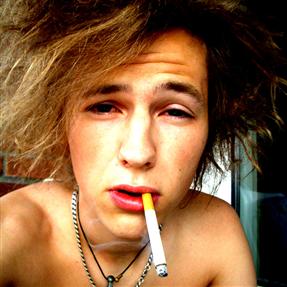 Lasse Gjertsen uses video editing techniques akin to music sampling to create new digital media compositions. In the video below called Amateur he creates a cut-up illusion of himself jamming on drums and piano. In another video he makes an appearance as a human beatbox.
Lasse also creates animations and a good introduction to his creative influences can be found in Jeg går en Tur - A self portrait that you can watch below: In animation, EVERYTHING is possible!
Check out Lasse's music page for some fine electronic tunes.
Via Kottke.org
Amateur - Lasse Gjertsen
Jeg går en Tur - A self portrait by Lasse Gjertsen
Monday, November 13, 2006
Instructional Music Video Mashup
Kel McKeown: Instructional Video
A mashup masterclass and classic example of creative cut-up techniques. Part of the fun is learning how it's done.
A mashup masterclass and classic example of creative cut-up techniques. Part of the fun is learning how it's done.
Saturday, November 11, 2006
WGBH Lab: Video Sandbox

The WGBH Lab is an online destination and initiative designed to help independent media makers. Selected video clips from the WGBH Media Library are being cleared for copyright and made available for people to cut, loop and mashup via the Lab Sandbox.
All clips are made available in QuickTime’s native .mov format under Creative Commons license Attribution-Noncommercial-ShareAlike 2.5 .
All clips are made available in QuickTime’s native .mov format under Creative Commons license Attribution-Noncommercial-ShareAlike 2.5 .
Thursday, November 09, 2006
New Perceptions of Self in the Age of Social Media
These four time-lapse videos show human evolutionary processes and cosmetic transformations over varying periods of time. These type of clips became significantly popular via YouTube and other new media outlets during the latter part of 2006.
I have posted the clips here in order of appearance on YouTube, over the 3 months of August, September and October (dates may be innacurate). Each successive video was compiled over a longer period of time apart from the final clip which was shot relatively quickly and digitally manipulated later.
For the first two videos shown below, the viewing figures quickly reached into the millions each and the level of interest was high across many important forms of media dissemination including blogs, social networks and mass media news outlets.
The clips continue to capture the imaginations of millions and it seems fitting to profile the trend in a single post. There's obviously a powerful fascination with the aging process and the technique of projecting these visions of accumulative degenerative processes over time. The fourth clip, possibly influenced by the success of the earlier videos, shows the power of cosmetic / technological practices to promote an image of desirability, albeit dependent on particular cultural perspectives and identification. Click through to the YouTube sources to get further details and comments.
More about this type of photography at Wikipedia Time-lapse
I have posted the clips here in order of appearance on YouTube, over the 3 months of August, September and October (dates may be innacurate). Each successive video was compiled over a longer period of time apart from the final clip which was shot relatively quickly and digitally manipulated later.
For the first two videos shown below, the viewing figures quickly reached into the millions each and the level of interest was high across many important forms of media dissemination including blogs, social networks and mass media news outlets.
The clips continue to capture the imaginations of millions and it seems fitting to profile the trend in a single post. There's obviously a powerful fascination with the aging process and the technique of projecting these visions of accumulative degenerative processes over time. The fourth clip, possibly influenced by the success of the earlier videos, shows the power of cosmetic / technological practices to promote an image of desirability, albeit dependent on particular cultural perspectives and identification. Click through to the YouTube sources to get further details and comments.
Me: Girl takes pic of herself every day for three years
Noah takes a photo of himself every day for 6 years
Living My Life Faster - 8 years of JK's Daily Photo Project
Dove - Evolution
More about this type of photography at Wikipedia Time-lapse
Sunday, October 29, 2006
Bent Circuit Training
Circuit Bending
Students learn the art of Furby reprogramming in a circuit bending workshop with Ben Goldstone. Below, an adept demonstrates the fruits of circuit bending knowledge as applied to a Kawasaki toy guitar.
cicuit bent "Double Neck" kawasaki toy guitar
Kawasaki motorcycle company licensed DSI Toys to use their name on a line of musical products. Unfortunately it's difficult to find online info about these particular electronic toys. If your interested in circuit bending and modifications to electronic sound toys here are some links worth exploring:
Metalriffs.com Guitar Toy Museum - a small picture gallery of electronic guitar toys.
Miniorgan.com - a private collection of rare small music keyboards and vintage musical electronic toys.
WarrantyVoid - the electronic sound toy and keyboard modification site.
Wikipedia Circuit bending - provides info and links to other websites.
If you're looking for online virtual sound toys and interactive music guides see the Museum of Sound Toys.
Thursday, October 26, 2006
Recycled Culture: David Ellis and the Art of Double Bass
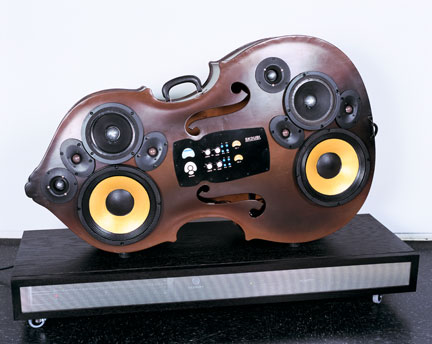 This work by artist David Ellis combines the body of a double bass with modern day audio hardware and electronics.
SKDubs gold (double bass boombox fiddle)
36 x 50 1/2 x 17"
Medium-modified double bass fiddle, spraypaint, casters, oak, plywood, metal, iPod, two tube pre-amps, B and C mids and tweeters, Electro-voice woofers, JVC tweeters, Crown XLS 602 Poweramp, and Behringer equalizer - 2005.
Via Hulger.org where you can find lots more interesting and arty contemporary designs.
The Double Bass
Along with classical music, the double bass has found its place in genres such as the blues, bluegrass, jazz, rock and roll, rockabilly, psychobilly, drum and bass. It has been used widely in pop and rock music on recordings by artists like Kate Bush, Bob Dylan, Peter Gabriel and Frank Zappa. A well known example being the Lou Reed song "Walk on the Wild Side" where session musician Herbie Flowers created the distinctive sounding bass hook, by using a mix of old and new sounds. He recorded one part on acoustic upright and then overdubbed a crossing part a major tenth above on electric fretless bass. The song was later recycled by other artists including A Tribe Called Quest who used a sample of it in "Can I Kick it?" - You can just about hear it on the intro of the video remix below. For more examples of recordings using double bass, see this thread from the TalkBass forums discussing Examples of Upright in Pop Music.
Perceptions
David Ellis's work evokes some interesting perceptions through the marriage of old and new world technologies.
At first site the juxtaposition creates a slight element of cognitive dissonance, a clash between the older acoustic culture and the contemporary electronic culture. However, the sense of discomfort is lessened by the idea the two cultures are not completely contradictory. The fundamental function of sound reproduction, for the purpose of music and entertainment, remains intact. In fact the instrument has merely been rewired, the strings replaced by electric wires.
Originally the source of sound was generated by a human drive mechanism. The machinery of bow and fingers controlled the perceived pitch, loudness and tone production. These have been replaced by electronic counterparts. The output of the iPod is the sound source, the amplifier and equalizer control the loudness and tone respectively.
The acoustically resonating wooden body becomes the architecture for the electro-magnetic speakers and electronics which are embedded in the belly. The electronics span a progression of successive developments where each stage builds on the past, from mechanical, to electronic valve, transistor and finally digital micro-chip.
There's much to contemplate in this piece that embraces change and cultural heritage: the new functionality, shape, symmetry, the handle ontop, the missing head/neck, the fact that it's no longer 'upright'.
Detritus.net is a web site devoted to recycled culture. Budding detrivores wishing to make new creative works out of old ones will find it a good source of inspiration.
Resources
Wikipedia: Conceptual art
Friday, September 22, 2006
Negativland - Gimme the Mermaid
From nakedrabbit
This piece was commissioned by the experimental sound collage group Negativland for the video compilation, "Our Favorite Things," soon to be released. The track had been cut by Negativland several years before, an audio document of their problems with copyright/trademark issues concerning their "U2" album. Many years and a painful settlement later, they had successfully transformed their experience into even more art, and a little activism besides. This little piece, made on Disney equipment after hours when no one was looking, remains quite popular. San Francisco experimental filmmaker Craig Baldwin has been kind enough to include it in "culture jamming" programs he has organized throughout the US and Europe. Several times has it been used in conferences and on panels about copyright for the legal profession. And it's fun, to boot. The statute of limitations has apparently run out on this piece, and it is now considered perfectly legal. What a relief!
Negativland is a small collective of artists and activists that create music and videos using extensive sampling and collage techniques. Further documentation can be found at Wikipedia Negativland.
Update: WFMU's Beware of the Blog has a series of MP3s with Negativland's Mark Hosler giving a presentation at NYC's New School - Negativeland: Illegal Art
Monday, September 18, 2006
Let Me Tell You What It's All About
Provided By: Realtablist
"I made a little composition here using ableton live, 3 midi controllers and the Rodec scratchbox. The EFX inserts of the Rodec scratch mixer enables me to use ableton as an efx unit, drum machine and loop station."
Subscribe to:
Posts (Atom)